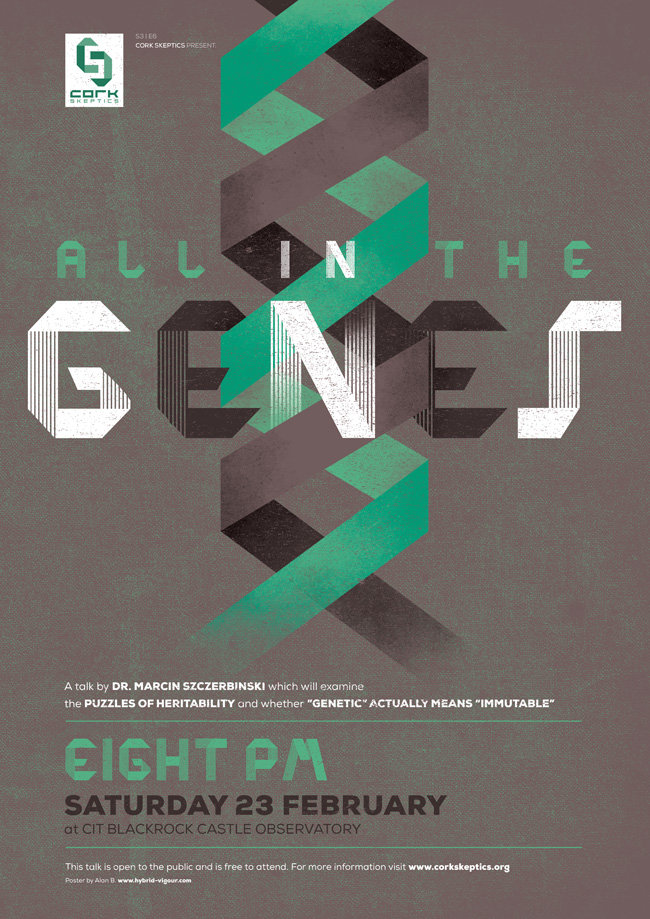
This talk by Dr. Marcin Szczerbinski, Lecturer in Applied Psychology at UCC, will explore genetics and the puzzles of heritability. What does it mean to say that a trait is heritable? Is there a gene for schizophrenia or a “gay gene”? What can we learn from looking at cases of identical twins raised apart, or indeed from adopted children raised together? And does genetic actually mean immutable?
These and similar questions will be addressed during what promises to be a truly insightful talk.
About the speaker: Dr. Marcin Szczerbinski is a Psychology graduate of the Jagiellonian University in Kraków, Poland, and of the Department of Human Communication Science, University College London. From 2001 until 2011 he was a lecturer at the Department of Human Communication Sciences, University of Sheffield, where he contributed to a number of undergraduate and postgraduate programmes, particularly in Speech and Language Therapy. He joined UCC in January 2011.
This talk by Jennifer Keane will examine the Burzynski Clinic and its purported side-effect free cure for cancer. Jen has kindly supplied the following summary of her talk:
Stanislaw Burzynski has a cheap, effective, and side-effect free cure for cancer, and the FDA don’t want you to know about it. For over 30 years, Burzynski claims he has treated cancer patients who had no other options, and given them back their lives. In the past, most of Burzynski’s patients have been in America, though recently, a surge of celebrity-led publicity surrounding some UK patients and their fundraising efforts means that Burzynski has well and truly crossed the pond. Increasing numbers of UK, and now Irish patients are signing up for treatment, and while some patients are claiming shrinking or disappearing brain tumours, many more seem a lot further from success.
In this talk, I hope to shine a critical light on Burzynski’s treatment, the financial burden that it represents for those who sign up for it, and whether or not he is really offering a cure, or just expensive false hope.
About the speaker:Jen became interested in scepticism and science investigation while in college, when a group project on clinical trials ended up highlighting the problems with trials, and the inconsistency in their quality, execution, etc. The group project sparked an enduring interest in clinical trials, and science communication, which would ultimately culminate in her winning the Whittaker Award, twice consecutively, for talks on the TGN1412 clinical trials, and on biofuels. She graduated from NUI Maynooth with a double honours degree in Biology and Computer Science, and is currently pursuing a MSc with the Open University.
Jen blogs and tweets as Zenbuffy, and began writing about about science and scepticism in 2009, and has covered topics such as homoeopathy, psychics, miracle cures, and science reporting, to name but a few. Though always an area of interest, her father’s battle with cancer has made the area of cancer cures and quackery a particularly important one for her.
This is a phrase that often comes to mind when people question the value and utility of science, or diminish its importance in the world today.
It cuts through the objections: that science can be biased, or imperfect, or financially driven, or chaotic, or fraudulent, or philosophically unsound, or just one idea among many.
Sometimes, these criticisms are valid. There are many instances where science has been hampered by fraudulent and unethical behaviour, where scientists have taken appalling short cuts and or adjusted data because it didn’t fit preconceived notions, where bullying and a dogmatic over-reliance on unsound theories has hampered progress. You could write a book on it.
And yet, planes fly.
Big ones too. Gigantic 300 tonne planes, travelling at 900 kilometres per hour, at 40,000 feet above the ground. Right now, a few of them are routinely ploughing their way through the stratosphere en…
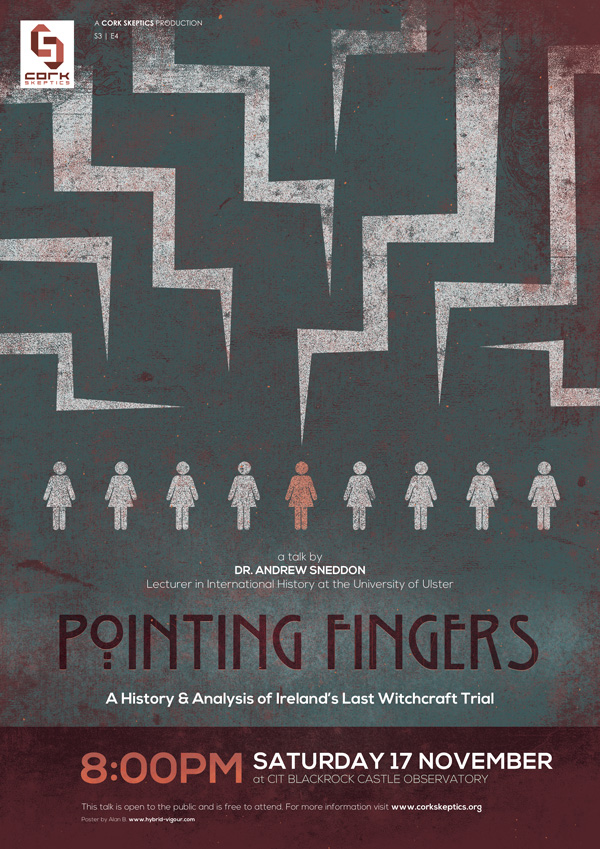
Our next meeting will take place on Saturday 17th November at Blackrock Castle Observatory, starting at 8.00pm. The talk is by Dr. Andrew Sneddon, lecturer in International History at the University of Ulster.
This talk will re-examine Ireland’s last prosecution for witchcraft at Carrickfergus Assize Court in Co. Antrim in March 1711. It will explore the reasons why eight women found themselves in the dock accused of causing the possession, by means of witchcraft, of a young woman, Mary Dunbar. It will also explore why, in a period of increasing scepticism towards ‘proving’ the crime of witchcraft all over Europe, the women were found guilty under the sixteenth-century, Irish Witchcraft Act. This will all be placed in its theological, intellectual and legal context by exploring the European ‘witch-craze’ of the early modern period.
About the speaker: Dr Andrew Sneddon is lecturer in history at the University of Ulster, specialising in social and intellectual history, exploring through this the religious, legal, medical, and ‘supernatural’ histories of Britain, Ireland and, to a lesser extent, Europe. He has published widely in these fields and in 2008 published a biography of the sceptical witchcraft theorist and bishop of Down and Connor, Francis Hutchinson (1660-1739). He is currently writing an account of the Islandmagee trial, to be published in early 2013 and entitled, Possessed by the Devil, as well as a tome that will explore witchcraft and magic in Ireland, 1586-1949, which is due to be published by Palgrave Macmillan in 2014.
Our next meeting will take place on Saturday 20th October, at Blackrock Castle Observatory, starting at 8.00pm. The talk is by Keir Liddle of Edinburgh Skeptics, who will take a close look at the Nocebo Effect. Keir will join us from Scotland, via the sufficiently advanced technology* of Skype.
On the night, we will also have a short (live!) presentation from the editor of Walton Magazine, a new quarterly STEM publication based in Cork.
Most people are familiar with the placebo effect—where an inert substance appears to cause an improvement in a patient’s symptoms (or at least makes them believe things are getting better). But we may be less aware of it’s corollary, the nocebo effect.
In medicine, a nocebo reaction or response refers to harmful, unpleasant, or undesirable effects a subject manifests after receiving an inert dummy drug or placebo. Nocebo responses are not chemically generated and are due only to the subject’s pessimistic belief and expectation that the inert drug will produce negative consequences. In these cases, there is no “real” drug involved, but the actual negative consequences of the administration of the inert drug, which may be physiological, behavioural, emotional, and/or cognitive, are nonetheless real.
In this talk placebo and nocebo are explained and pitted against each other. Are they both real? How can we study nocebo effects? And what implications do nocebos have for modern clinical practice?
Keir Liddle is a PhD student at the University of Stirling, and on the Edinburgh Skeptics committee. He founded the longest free skeptical festival in the world (Skeptics On The Fringe) and has a longstanding interest in placebos, nocebos and their implications. In this talk he draws on recent and past research into nocebo effects to argue that they are really a lot more important than anyone seems to give them credit for.
We are beset, these days, with people making claims about products, services and viewpoints that have little or no scientific backing or evidence. Websites, advertisements and magazine articles sometimes contain extravagant claims about products and services that are guaranteed to change your life, make you rich, or provide therapies that are beyond the means of modern medicine. Often, clever persuasion techniques are used that sound convincing at first sight, but which do not make much logical sense on closer inspection. These techniques are called “Logical Fallacies”: flawed arguments used to persuade the unwary. Logical fallacies are often used simply to distract people away from a more rigorous examination of a claim. The following are some logical fallacies in common use.
Appeals to Emotion: Emotional appeals are the mainstay of many baloney merchants. By linking their ideas with pleasant, soothing imagery, or associating their opponents’ ideas with disgusting or threatening pictures, the expectation is that the reader is will be persuaded to accept the proponent’s point of view. There are many examples of this, particularly when the topic is a “hot button” one, such as abortion, childhood vaccinations, vivisection, climate change or nuclear power. Appeals to emotion are used throughout the advertising industry as a means to associate products with well-being and health.
Appeals to Celebrity: A key strategy among many advertisers of nonsense is to associate their products with well known personalities, both living and dead. A testimonial or photo-opportunity with a celebrity is hugely desirable, but where this is not possible, it can be just as effective to insert an image of Einstein, Mahatma Gandhi or a famous hollywood film star. Celebrities have huge public appeal and can drive enormous interest in products and services. They are rarely experts, however, and are prone to the same biases and mistakes as the rest of us. A celebrity endorsement does not necessarily indicate that a product or service is any good.
“Magic” words: Seemingly scientific words regularly appear in the the literature and websites of nonsense pedlars. These words include “vibrations”, “energy”, “life-force”, “quantum”, “magnetic” and “psychic”. While they are meant to convey a sense of how their procedures work, they are usually used in contexts that make no sense from a scientific perspective. Energy, magnetism, vibrations and quantum have very specific meanings for scientists. They are often used inappropriately when applied to the many healing or therapeutic solutions on offer in the mainstream media. Instead, the words are a short-hand for magic: a word used to describe the inexplicable.
Too Good To Be True: Some claims are breathtakingly sensational. According to some, a cure for all types of cancer is available right now, others promote get rich quick schemes, while yet others claim that free energy is in our grasp. These are extraordinary claims that sound almost too good to be true. While we would all like silver bullet solutions to our problems, the reality is often more difficult and complex. When great breakthroughs do take place, they come under heavy scrutiny and are surrounded by an enormous media fanfare, both positive and negative. In this context, claims by single proponents require extensive cross-checking and verification before they can ever be accepted. As the saying goes: “if it sounds too good to be true, it probably is”.
Black Or White: A Black Or White claim, also called a “false dilemma”, is one that limits alternative explanations to a very small number of possibilities, often just one or two. If a strange light is seen in the sky, it MUST be a UFO. If a strange object is seen on the road at night it MUST be a ghost. Other possible alternatives are not even mentioned. False dilemmas are also used to convince people of a viewpoint by presenting it as the only alternative to the mainstream view. An example is where homeopathy is promoted where normal medicines have significant side effects. Just because there are problems in mainstream medicine doesn’t mean that homeopathy is an effective alternative.
Conspiracy: Sometimes we hear proponents of strange claims make allegations about Big Medicine or government or a capitalist elite suppressing their ideas for their own nefarious purposes. While conspiracies do sometimes take place, it is almost trivially easy to resort to a conspiracy theory to explain a setback or an unforeseen circumstance. Other possibilities, such as misfortune, incompetence and indifference, are often more likely explanations.
None of these arguments, in themselves, can prove that a person is talking baloney. Indeed, worthwhile, serious ideas may also be supported by poor reasoning. However, if a proponent only uses logical fallacies to support their products or viewpoints, then you should be sceptical of the claims they are making.

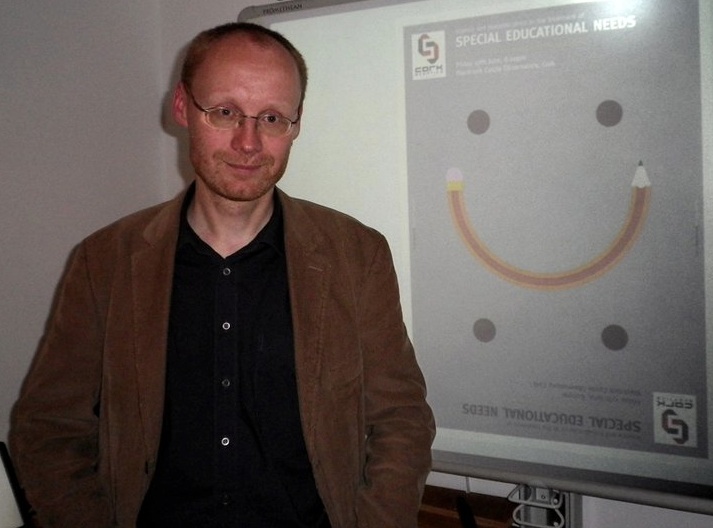 About the speaker: Dr. Marcin Szczerbinski is a Psychology graduate of the Jagiellonian University in Kraków, Poland, and of the Department of Human Communication Science, University College London. From 2001 until 2011 he was a lecturer at the Department of Human Communication Sciences, University of Sheffield, where he contributed to a number of undergraduate and postgraduate programmes, particularly in Speech and Language Therapy. He joined UCC in January 2011.
 Jen became interested in scepticism and science investigation while in college, when a group project on clinical trials ended up highlighting the problems with trials, and the inconsistency in their quality, execution, etc. The group project sparked an enduring interest in clinical trials, and science communication, which would ultimately culminate in her winning the Whittaker Award, twice consecutively, for talks on the TGN1412 clinical trials, and on biofuels. She graduated from NUI Maynooth with a double honours degree in Biology and Computer Science, and is currently pursuing a MSc with the Open University.


 Cork Skeptics